Table of Contents
You hurt something. You know you need help. You got a referral, you called the clinic, and the first available appointment is three weeks out.
So you wait. You rest it, like they told you to. And by the time you get to your first session, you're not just recovering from the original injury. You're recovering from three weeks of doing nothing.
HURT! Digital Recovery exists because that gap is real, it's common, and it doesn't have to happen that way.
What Is Digital Recovery?
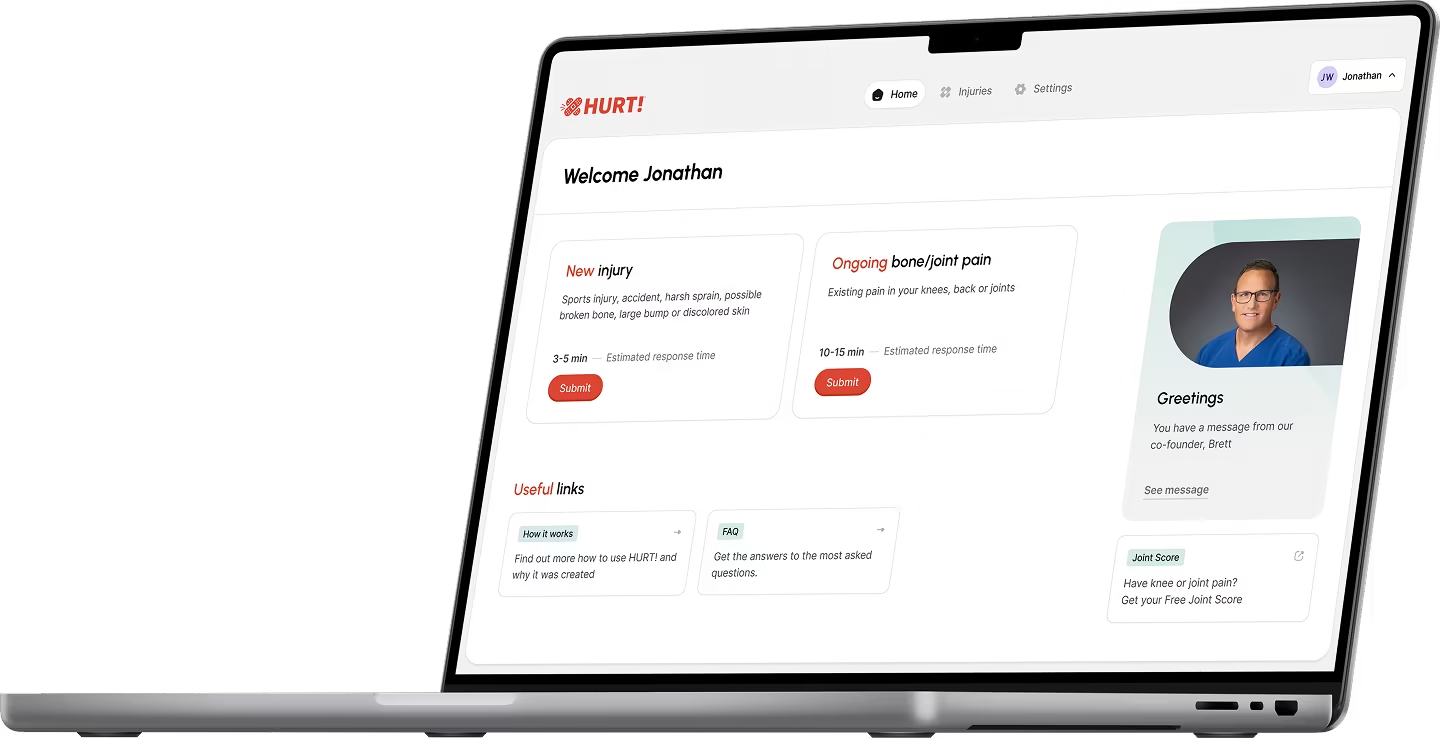
HURT! Digital Recovery is a structured program you complete at home, built around the clinical relationship you already have, not separate from it.
Here's how it works. Your clinician evaluates your condition and builds a personalized plan. You complete your exercises at home using motion capture technology that gives you real-time feedback on your form. And your clinician stays connected to your progress throughout, reviewing how you're doing, adjusting your program remotely, and deciding when you need to come back in.
The key word is connected. HURT! Digital Recovery is the digital layer that keeps your clinical relationship active between visits. If you're already being seen in clinic, digital recovery creates a hybrid: your clinician sees you in person when hands-on work is needed, and follows your progress at home in between. The relationship doesn't pause when you leave the building.
It is a clinical program. Not a video library. Not a routine you found online. The difference is accountability, and a clinician who knows your condition, set your plan, and reviews how you're doing.
What Does the Research Actually Say About Recovering at Home?
This is a fair question to ask, and it deserves a real answer rather than a marketing one.
A systematic review and meta-analysis of telerehabilitation for musculoskeletal disorders found it to be an effective option for recovery, with cost advantages compared to conventional delivery (Molina-Garcia et al., Annals of Physical and Rehabilitation Medicine). A 2025 network meta-analysis in the Journal of Orthopaedic & Sports Physical Therapy compared different types of remote programs for chronic musculoskeletal pain and found that outcomes depend heavily on how the program is delivered (Zou et al.). Remote rehabilitation for neck pain has been examined in a Cochrane review, and specifically in knee osteoarthritis in Clinical Rheumatology.
Here is the part that matters most, and it's the reason HURT! Digital Recovery is built the way it is: the structure is what does the work. A structured, clinician-built program is not the same thing as a set of exercises emailed to you as a PDF. What separates a program that works from one that doesn't isn't whether a clinician is watching in real time. It's whether there's a defined, clinician-built program behind it. The evidence supports the former. It does not support the latter.
Timing matters too. A systematic review with meta-analysis of randomized trials in acute low back pain found that starting physical therapy reduced short-term pain and disability compared to no physical therapy at all (McDevitt et al., PM&R). Rest without guidance is not the same as recovery. Three weeks of doing nothing is a decision, even when nobody made it on purpose, and deconditioning, guarding, and altered movement patterns don't wait for the appointment date.
How Is Digital Recovery Different from In-Person Recovery?
Neither is universally better. They serve different patients at different stages, and for many patients, they work best together.
In-person recovery is the right choice for complex presentations, acute post-surgical work, and cases that require hands-on manual therapy.
Digital recovery is a structured clinical option for patients with low-to-moderate complexity conditions, people in later stages of post-op recovery, and anyone facing access barriers: distance, cost, or a schedule that doesn't accommodate twice-weekly clinic visits.
For many patients, the answer is both. You start in clinic. You transition to digital as your condition stabilizes. Your clinician follows your home program and brings you back in when something warrants it. That's the hybrid model, and it's how HURT! Digital Recovery is most often used in practice.
Can I Do Recovery from Home?
For the right conditions and the right patient, yes. Home-based recovery through a structured digital program is a clinically sound option.
The key word is structured. Home recovery works when a qualified clinician has assessed your condition, determined you're an appropriate candidate, and built a program specific to your situation. HURT! Digital Recovery is that program. It's clinician-directed, completed at home.
Who Is a Good Candidate for Digital Recovery?
Good fit:
- Motivated patients who will complete their sessions consistently
- Low-to-moderate complexity MSK conditions
- Later-stage post-op recovery (end-stage, return-to-activity phase)
- People with geographic or scheduling barriers to in-person visits
- Patients who started in-person recovery but dropped off due to cost, schedule, or distance
Not a good fit:
- Acute post-surgical cases requiring hands-on work or direct tissue work
- High-complexity presentations requiring manual therapy
- Significant instability, acute inflammation, or presentations where in-person assessment is clinically indicated
If you're not sure which category you're in, that's what the evaluation is for. Your clinician makes that determination.
How Does HURT! Digital Recovery Work?
Step 1: Submit your situation. Visit hurtapp.com/for-patients. An orthopedic-trained clinician reviews your case and gives you structured guidance on your next steps.
Step 2: Get evaluated. Once you're navigated to a practice, a clinician conducts an evaluation and determines the right pathway for your condition, complexity level, and goals.
Step 3: Receive your personalized plan. Your clinician builds a structured plan specific to your condition. Everything is set before you begin.
Step 4: Complete your exercises at home with real-time form guidance. Using your phone or tablet, you complete your exercises at home. Motion capture technology gives you real-time feedback on your form as you move. No wearables, no special equipment.
Step 5: Your clinician reviews your progress and brings you back in when needed. Your clinician stays connected to how you're doing between sessions, and can see whether you're progressing, whether your consistency is holding, and whether anything is changing that warrants attention.
That ongoing visibility does two things. It extends what your clinician can see beyond a single appointment. And it helps them decide when you need to come back in. If your progress plateaus, or something changes, your clinician sees it when they review your data and follows up before a small issue becomes a setback.
The goal is to keep you moving forward at home for as long as that's appropriate, and to bring you back into the clinic at exactly the right moment. Not too early, not too late.
What Conditions Does HURT! Digital Recovery Support?
Low back pain, neck and shoulder, knee pain, posture, prehab (pre-procedure preparation), end-stage post-op recovery, return to work, youth injury prevention, balance and fall prevention, and joint-friendly fitness.
If your condition isn't on this list, the evaluation step will clarify the right pathway. Digital recovery isn't right for every condition, and your clinician will tell you that honestly if it isn't the right fit for you.
What Is Motion Capture Recovery?
Motion capture technology uses your device to track your movement during exercises and give you real-time feedback on your form as you go. You can see yourself moving and self-correct in the moment, without a clinician physically present.
No wearables. No special equipment. Your phone or tablet is enough.
Your clinician uses the resulting data to review your progress, understand how your movement is changing, and adjust your program. The technology keeps your clinician connected to your recovery. It doesn't replace them.
What Does Digital Recovery Cost?
We keep this simple. HURT! Digital Recovery is cash pay only, which means no insurance to verify and no surprise billing. It's FSA/HSA eligible, and you can spread the cost into smaller payments through Affirm. Recovery works best as a team effort, so Digital Recovery is designed to work right alongside your doctor and your clinical team.
What Happens if My Pain Gets Worse During Digital Recovery?
Your progress is reviewed throughout HURT! Digital Recovery. If something changes, your clinician can see it in your data and follows up, whether that means adjusting your home program or determining it's time to return to the clinic.
HURT!'s 24/7 orthopedic guidance is also always available if something acute happens. You submit your situation, an orthopedic-trained clinician reviews it, and you get structured direction, not a callback three days later.
You are not managing your recovery alone.
How Does My Clinician Know When to Bring Me Back Into the Clinic?
Your clinician stays connected to your recovery throughout the program, reviewing your progress data, tracking your consistency, and watching for changes that warrant attention.
If your progress plateaus, your pain scores change, or something looks concerning in your data, your clinician sees it on review and follows up directly. That ongoing visibility is what makes it possible to extend your program at home safely, and to bring you back into the clinic at exactly the right moment.
The clinical relationship doesn't pause when you leave the building. Distance doesn't change that.
From the Desk of John DeLucchi, PT, DPT, MBA
Often patients think recovery happens in the clinic. It doesn't. Most of it happens in the hours between sessions. Clinically, this isn't complicated: match the program to what the patient can actually sustain, and consistency plus gradual progression do the rest.
Getting Started
If something is bothering you and you're not sure what to do next, start there.
Visit hurtapp.com/for-patients. Submit your situation. An orthopedic-trained clinician will review your case and give you structured guidance, including (if asked) whether HURT! Digital Recovery is the right fit for where you are right now.
You don't have to figure it out alone. And you don't have to wait three weeks to start getting better.
References
- Molina-Garcia P, et al. Effectiveness and cost-effectiveness of telerehabilitation for musculoskeletal disorders: a systematic review and meta-analysis. Annals of Physical and Rehabilitation Medicine. doi.org/10.1016/j.rehab.2023.101791
- Zou H, et al. The relative efficacy of different types of telerehabilitation for managing chronic musculoskeletal pain: a network meta-analysis. Journal of Orthopaedic & Sports Physical Therapy. doi.org/10.2519/jospt.2025.13366
- Fandim JV, et al. Telerehabilitation for neck pain. Cochrane Database of Systematic Reviews. doi.org/10.1002/14651858.CD014428.pub2
- McDevitt AW, et al. Effect of physical therapy timing on patient-reported outcomes for individuals with acute low back pain: systematic review with meta-analysis of RCTs. PM&R. doi.org/10.1002/pmrj.12984
- Pak SS, et al. Comparing digital to conventional physical therapy for chronic shoulder pain: randomized controlled trial. Journal of Medical Internet Research. doi.org/10.2196/49236
- Tore NG, et al. The quality of physiotherapy and rehabilitation program and the effect of telerehabilitation on patients with knee osteoarthritis. Clinical Rheumatology. doi.org/10.1007/s10067-022-06417-3


.png)