Table of Contents
Forty million people ask ChatGPT a health question every single day. Somewhere in that number is somebody's actual grandmother, propped up on the couch, asking her phone about her hip via voice chat because she just learned about it, and it's easier than dialing the office and explaining herself to a stranger.
More than half of those forty million are using it as an AI symptom checker for something they're feeling right now: a knee that gave out, a shoulder that won't lift past a certain point, a hip that's been talking back for a week [1]. This is not hypothetical trend, it's already happening before anyone picks up a phone or walks into an office. In this article, we'll discuss what happens in the gap between the ai answer and an actual appointment, and who's there to close it.
TL;DR: AI can answer the question, and now it can even book the appointment., but it still can't make the judgment call on whether that appointment is the right one at the right time. That's where a real orthopedic expert comes in.
Why Are Patients Asking AI First?
It makes sense. Something hurts, it's 9pm, and a chatbot answers in three seconds. No hold music, no explaining yourself twice, no feeling like a bother. Even grandma's figured that out. Seven out of ten health conversations with AI now happen outside normal clinical hours [1]. That tells you less about what patients trust and more about when the question actually shows up. Pain doesn't check the clock.
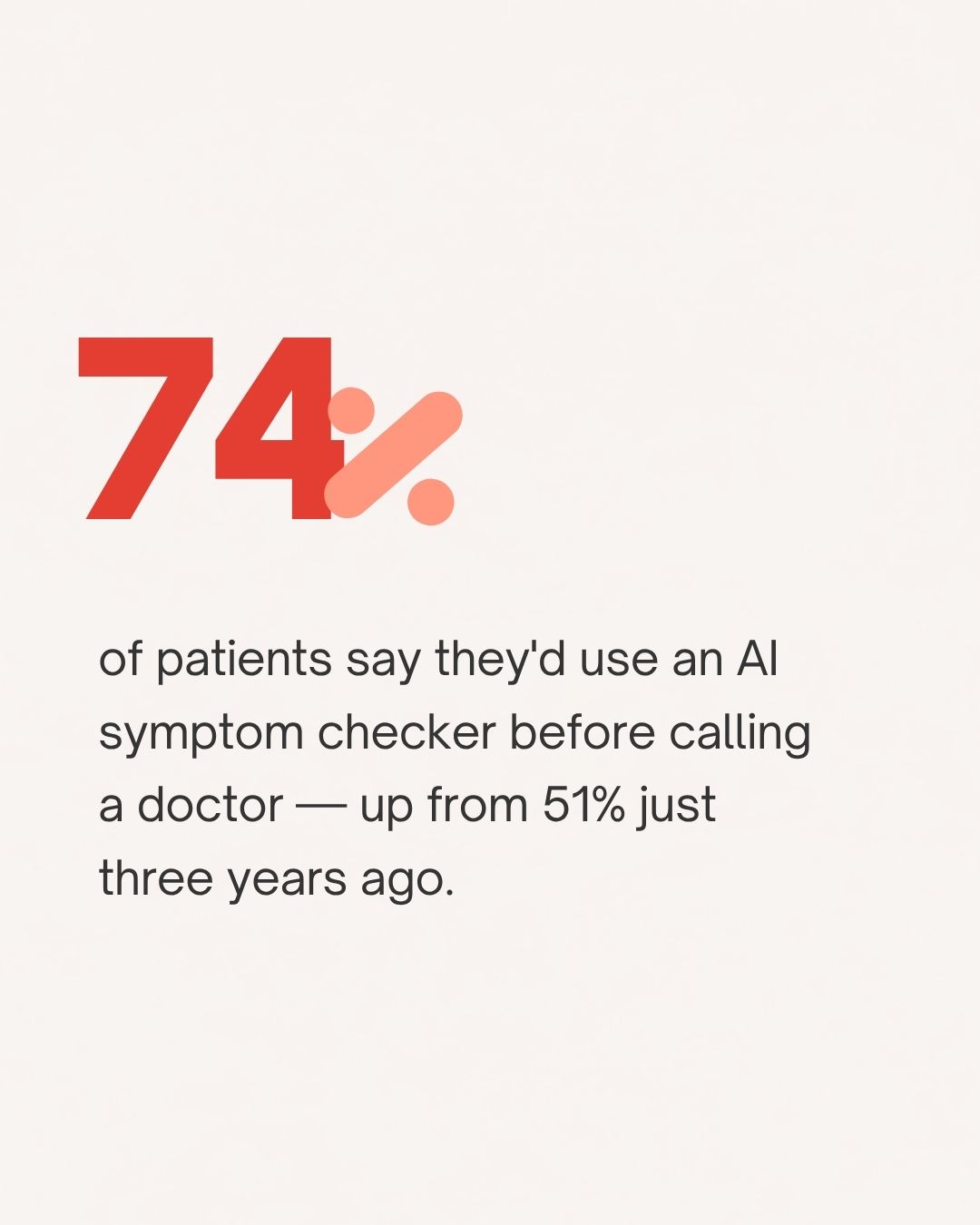
It's also the default path now. A 2025 Accenture survey found 74% of patients are willing to use an AI symptom checker before contacting a doctor, up from just 51% three years earlier [2].
On Google, the shift is structural: BrightEdge's three-year tracking study found AI Overviews now appear on 89% of healthcare search queries, up from 59% at the end of 2023 [3]. Pew Research's own review of nearly 69,000 real searches found people click through to an actual result only 8% of the time when that AI answer is on the page, compared to 15% when it isn't [4]. The old path, search, click, call, is quietly closing.
So Where Does an Orthopedic Expert Fit In?
We're not in the business of telling people to stop asking AI questions. Frankly, people are going to keep doing it, the same way they've always Googled a symptom before calling anyone. The job now is not to compete with that first instinct but to be the next thing that happens after it.
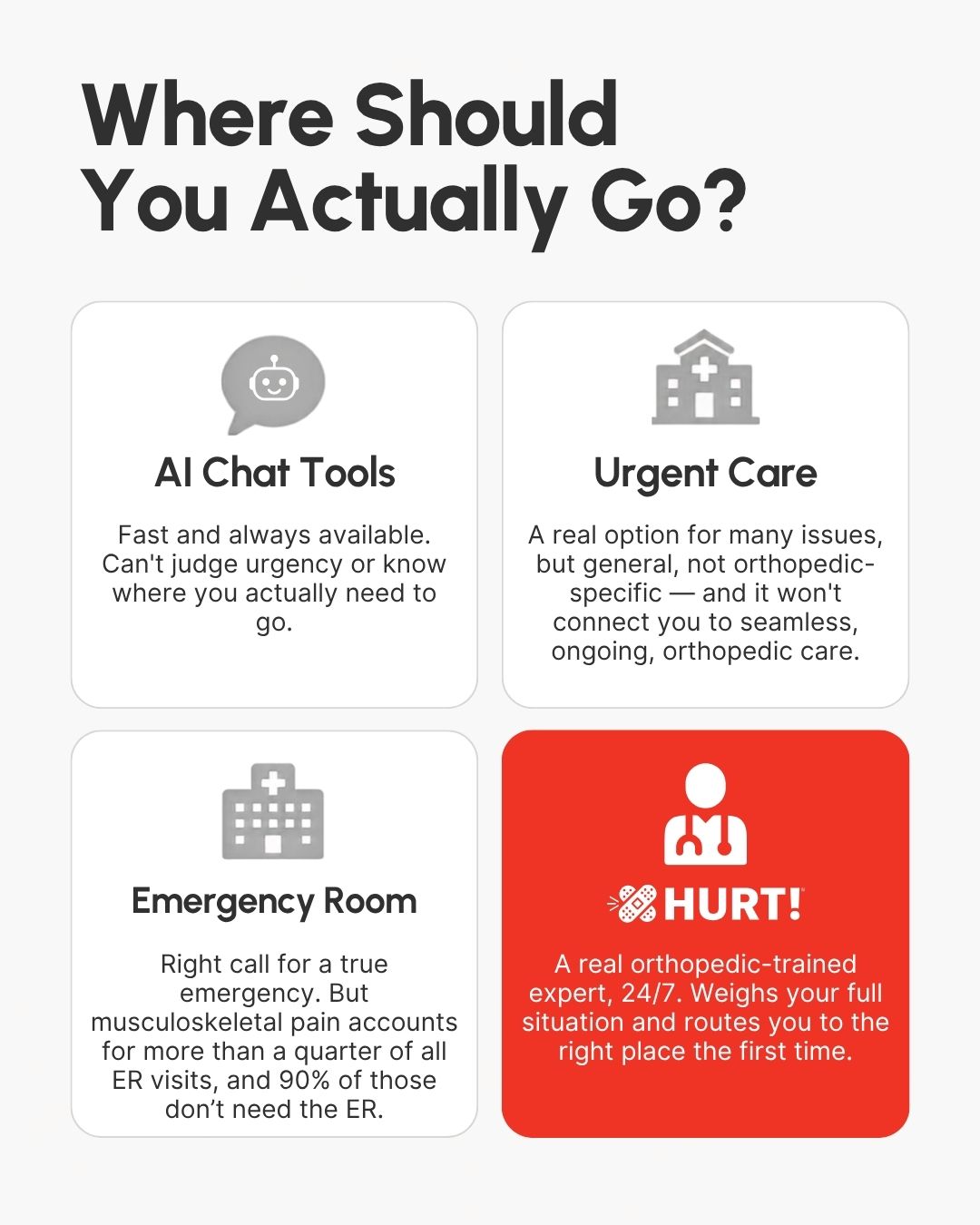
A real, 24/7 orthopedic-trained expert does what a chatbot can't. The expert hears the actual situation, makes a real judgment call about urgency, asks clarifying questions, and connects that patient to the practice that will actually see them, not a generic search result, and most importantly not an ER that didn't need to be their first stop. The AI might have answered the question, but a human expert closes the loop.
This isn't about capturing a lead for a practice's schedule, but rather about the person who was about to do nothing, or about to end up in the wrong place, and getting them to the right one instead. Sooner, and with someone actually paying attention to their specific situation. Getting patients to the right site of service at the right time is pivotal for their recovery journey, and for their wallet.
How This Plays Out, Step by Step
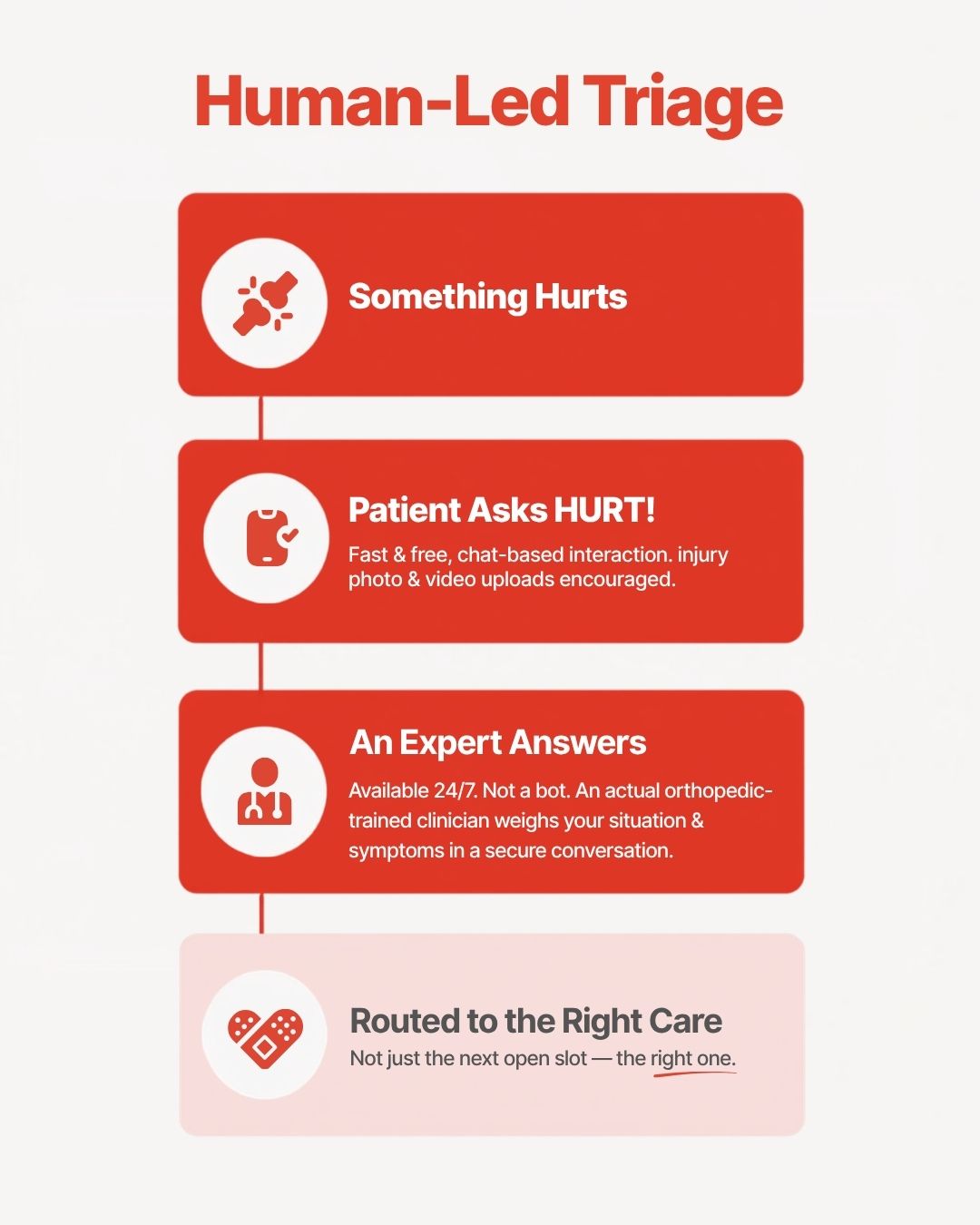
The first three steps below already happen today, on whatever chat tool or search engine a patient already has open, with or without HURT! in the picture. Nothing in that stretch is ours. Step four is where that changes, and where a real person, not another AI layer, actually enters:
- Something hurts. A patient feels it and wants to know what to do.
- They ask AI, or search. Fast, no waiting on hold, available at 9pm. Expected, not a mistake.
- AI answers, and can now even book something. But it's matching availability, not making a clinical call. No exam, no knowledge of the patient's actual practice or insurance, no real judgment on urgency.
- A real, live orthopedic-trained expert picks up exactly where that answer left off. Available 24/7, making the judgment call a scheduling match can't. Not a bot. Not another chat window. An actual clinician.
- The patient gets routed to the right care, not just the next open slot. The practice gets a patient who was already halfway to getting lost.

What Can't AI Do Yet?
Booking itself isn't the barrier it used to be anymore. Some AI chat tools can now book a real appointment directly, no phone call required. That closes the scheduling gap. It doesn't close the clinical one.
It can find an available appointment. It has no way to know if that appointment is the right one. Whether the provider it matched has any real connection to the patient. Whether the situation needs attention today or can wait. Whether a scheduling match is even the right kind of care to begin with. It's matching availability, not making a judgment call, and those are two very different jobs.
Here's the part that matters clinically, not just anecdotally. Mass General Brigham researchers ran 21 different AI models through 29 standardized medical cases, over 16,000 responses total, and published the results in JAMA Network Open this April. With limited symptom information, the same kind of thin description a patient would type into a chat window at 9pm, the models missed the correct differential diagnosis more than 80% of the time. Accuracy improved substantially once the models had labs and imaging to work with [5], information a chatbot never has because it isn't a clinician and it isn't in the room.
That's not a knock on the technology, but it is a straightforward limitation: an AI chatbot can inform someone, and now it can even schedule for them. What it still can't do is examine them, know their insurance or their actual practice down the street, or tell whether what they're feeling needs attention tonight or can wait until Monday. Fast and bookable isn't the same as fast and right.
That gap has a real cost. Musculoskeletal pain accounts for more than a quarter of all emergency department visits [6]. A meaningful share of those people never needed the ER at all. They needed someone to tell them where to actually go.
The Full Circle Moment
A 24/7 orthopedic-trained expert already closes the gap this whole article is about. That access works on its own, right now, no add-ons required.
But it can also be amplified by the rest of the HURT! product suite. Take hip and knee concerns specifically, the exact thing grandma was voice-chatting with AI about earlier. Joint Score™ turns that same moment into a structured, five-minute assessment instead of an open-ended chat that goes nowhere. It plugs directly into the triage access a practice already has, so there's no new system to learn and no team to retrain. For practices ready to support self-managed recovery past that first visit, HURT! Digital Recovery keeps that thread open between appointments, so support doesn't stop the moment a patient walks out the door.
Neither product replaces a practice. Both build on what's already working, and turning either one on is easy.
For a practices alike, that's the whole point of the HURT! suite working together: patients land in the right place the first time, stay connected well past the first visit, and nobody on staff has to manage that manually. For a patient, it's simpler than that. Less time stuck wondering where to go, and real convenient support waiting once they get there.
Common Questions
Q: Should patients stop using AI chatbots for health questions?
A: We don't recommend patients rely on AI chatbots for health-related questions, especially urgent ones. But telling them to stop wouldn't change how people actually behave. The real fix isn't stopping the first question. It's making sure a real next step exists after it.
Q: Should I use an AI symptom checker before calling a doctor?
A: It's a reasonable starting point for general information, but published research has found real accuracy limits with the kind of limited symptom detail a patient would type in on their own [5]. Use it to get oriented, then talk to someone who can actually make the judgment call, like our HURT! experts. It's a place to start, not a place to stop.
Q: Is 24/7 access through HURT! itself an AI chatbot?
A: No. It's a real orthopedic-trained clinician, every time, not a bot or an automated system. The AI conversation this article is about happens beforehand, on whatever tool a patient already has open, entirely separate from HURT!. Once a patient reaches HURT!, they're talking to an actual person, in a HIPAA-safe conversation, not a general-purpose chat tool where privacy protections vary by product and plan.
What Does This Mean for Your Practice?
If your patients are already asking AI before they call you, and the data says they are, the practices that win are the ones with a real next step already in place for the moment the chatbot's answer runs out. See how 24/7 access fits into your existing patient flow →
Sources
- OpenAI, "AI as a Healthcare Ally," January 2026, via Healthcare Dive
- Accenture Health, 2025 consumer survey, cited via Association of Health Care Journalists
- BrightEdge, three-year healthcare keyword tracking study (Dec 2023-Dec 2025)
- Pew Research Center, behavioral study of 68,879 Google searches, 2026, cited via SparkToro
- Mass General Brigham / JAMA Network Open, "Large Language Model Performance and Clinical Reasoning Tasks," April 13, 2026
- NCBI/PMC, "Patients with Musculoskeletal Disorders Presenting to the Emergency Department"

.png)